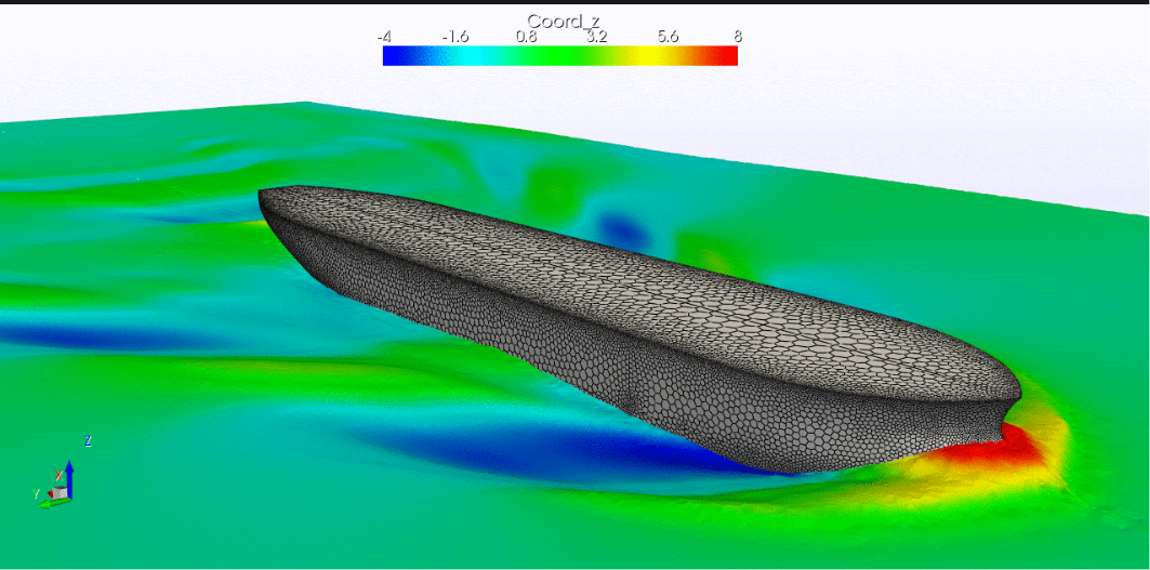
Polyhedral Meshing
Why Mesh Topology is the Secret to Accurate Wave Physics
Why Mesh Topology is the Secret to Accurate Wave Physics
In Computational Fluid Dynamics (CFD), we often focus on cell count as the primary metric for accuracy. However, when simulating time-accurate phenomena like wave propagation, the topology of the mesh—how those cells are connected—becomes the deciding factor between a physical result and a numerical artifact.
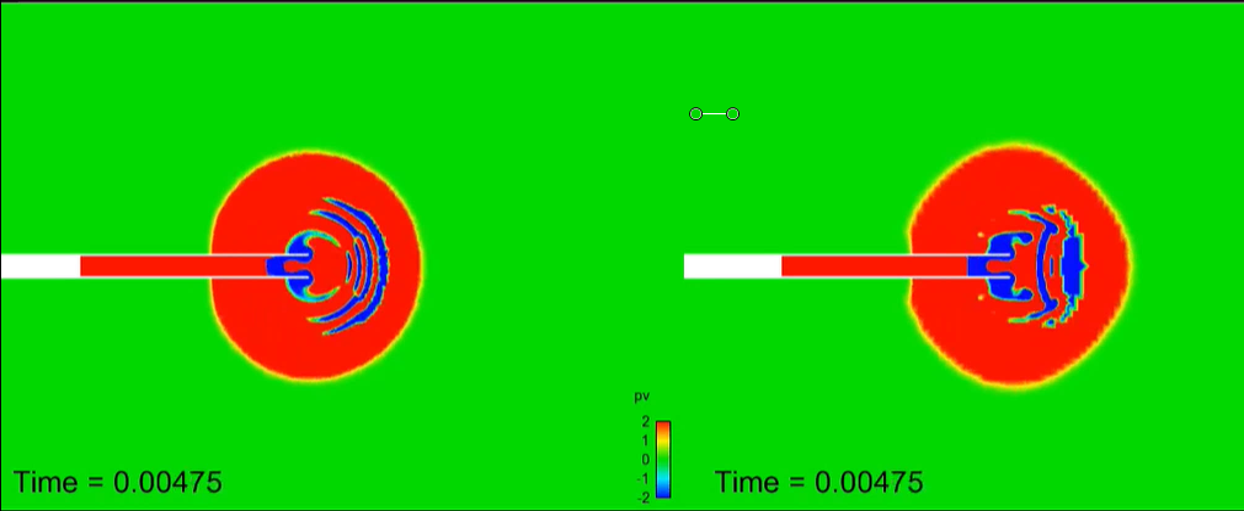
Let’s look at two meshes, the first (left hand side) based on the Ennova polyhedral mesh and the right-hand side is a more conventional cartesian mesh.
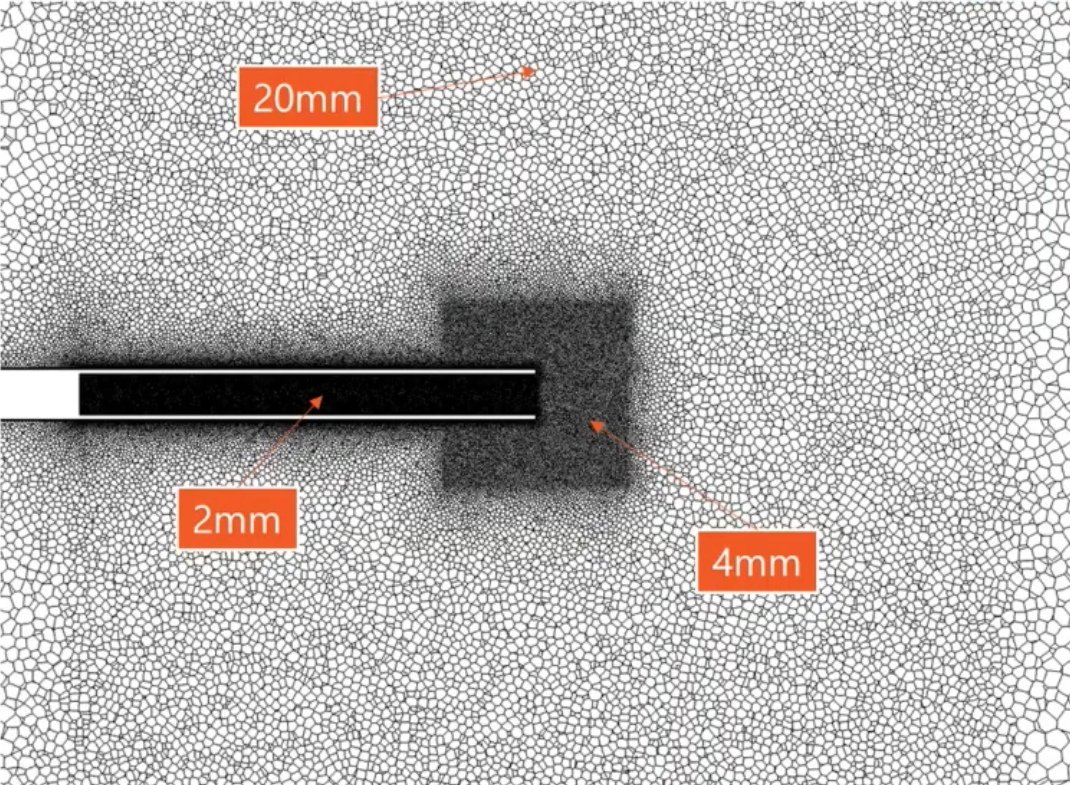
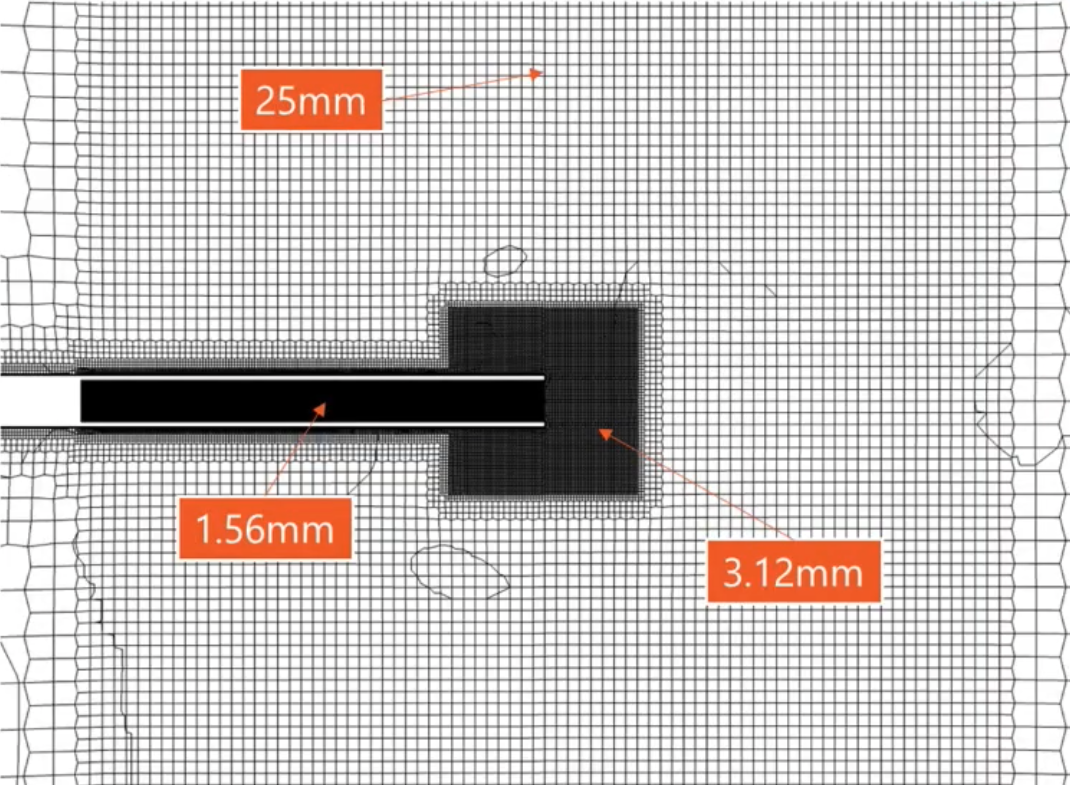
What you should pay attention to is the transition of the mesh element size from one element to the next. In the polyhedral mesh on the left, there are no obvious large jumps from one cell to another. In contrast, on the right, we can see rows and columns of elements of one size transitioning across a single face to elements with twice the length and width. In 3D, this will cause the element volume to change by a factor of 8 from one cell to the next.
Let’s see how that affects the quality of the result. Below we show the results of pulse of high-pressure air being driven down an open-ended pipe. When the pulse of air hits the end of the pipe there is a shock wave that propagates out into the open cavity. That is the real physical effect that we want to simulate. So far so good.
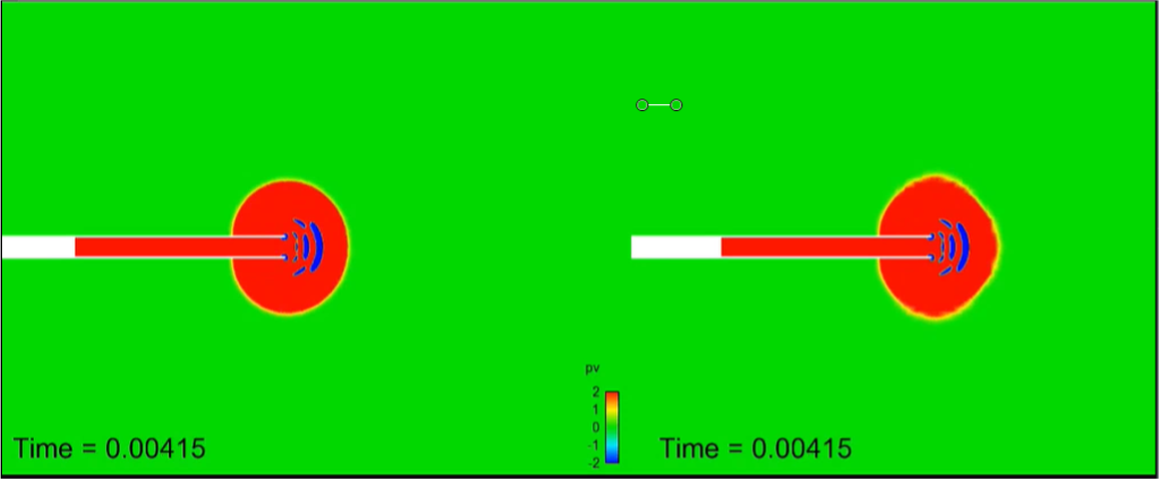
However, in the case of the cartesian mesh on the right below, we see something strange, something not physical, happening.
The sound wave seems to be bouncing or reflecting off empty space.
Also, if you look closely, you will see the red high-pressure area is not quite circular.
It appears the high-pressure area is propagating more quickly vertically and horizontally than it is diagonally.
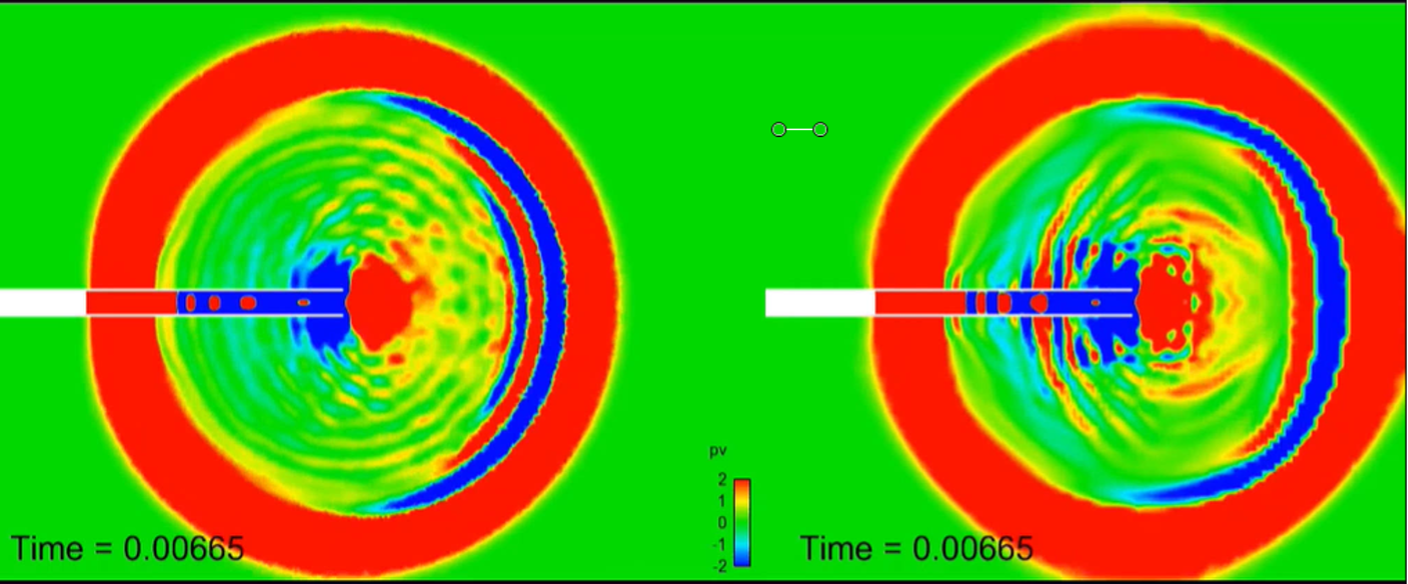
Below, as time progresses, things seem to be getting worse for the cartesian mesh. The rearward reflected waves are much larger in amplitude than for the polyhedral mesh. Additionally, the main blue pressure wave is very clearly not circular!
Many automated meshers rely on Cartesian or octree-based refinement. While fast to generate, these grids often create "hanging nodes" where a single large cell face meets several smaller ones.
As seen in the right-hand column of images, these abrupt transitions act as numerical discontinuities. When a wave passes through these zones, it encounters "speed bumps" that lead to:
In contrast, the left-hand column shows the same wave traveling through a smooth polyhedral mesh. By using a "Dualizer" approach—converting a tetrahedral base into a honeycomb-like polyhedral structure—we achieve a conformal transition.
Because polyhedral cells have a high number of neighbors (typically 12–14), the mesh is naturally isotropic. The wave "sees" the same resistance in every direction, allowing it to maintain its perfect spherical shape and sharp gradients without artificial damping.
| Feature | Smooth Polyhedral (Dual) | Cartesian (Octree) |
|---|---|---|
| Wave Shape | Perfectly Spherical | Distorted / "Squared" |
| Connectivity | Conformal (Shared Faces) | Non-conformal (Hanging Nodes) |
| Energy Loss | High Energy Preservation | High Numerical Diffusion |
An additional benefit of moving to an Ennova polyhedral mesh is a significant reduction in total cell count compared to octree-based Cartesian grids.
In a Cartesian mesh, refining the free surface or a complex hull requires a "power of two" cell splitting. This creates a massive number of redundant cells in the volume just to get the required resolution at the interface. Because Ennova’s polyhedral cells have 12–14 faces and a more flexible topology, they fill the 3D volume much more efficiently.
For a standard marine case, this results in:
The choice of mesh isn't just a matter of aesthetics; it is the foundation of high-fidelity physics. Whether you are resolving the complex interference of marine waves around a ship hull, capturing the sharp pressure gradients of shock waves in hyper sonics, or predicting the phase-accurate propagation of sound in aeroacoustics, a smooth polyhedral mesh ensures that the physics—not the grid—dictates the result.
The full video of this study can be found here: "https://youtu.be/pQtStdR2ivs"
Ennova Marine is the first dedicated marine application to recognize that accurate surface waves require a conformal mesh.